- Ausstellungen
- Begegnungen
- Studienzentrum
09/30/2026 Exhibition
Graphic Novel Exhibition at the Stadthaus Remembrance Site

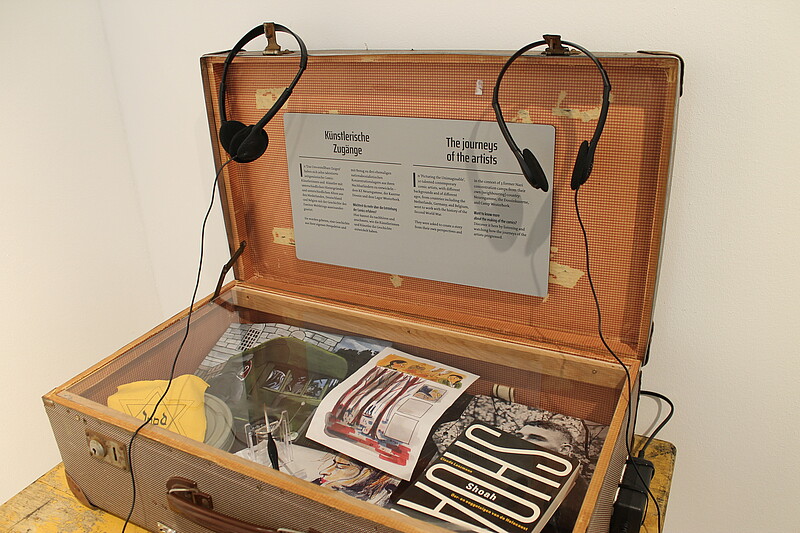
From September 30 to November 27, 2026, the Stadthaus Remembrance Site will present the exhibition “Picturing the Unimaginable” in a new, more mobile format.
Ten contemporary comic artists from the Netherlands, Germany, and Belgium have contributed to this graphic novel project. They have illustrated stories set in three former concentration camps—Neuengamme in Germany, the Kazerne Dossin in Belgium, and Westerbork in the Netherlands: Erik de Graaf, Melanie Kranenburg, Sterric, Jennifer Daniel, B. Carrot, Wide Vercnocke, Milan Hulsing, Tobi Dahmen, Jeroen Janssen & Arezoo Moradi, and Guido van Driel. Kazerne Dossin and Westerbork were transit camps where Jewish citizens of the Netherlands and Belgium were forced to live prior to their deportation. Neuengamme in Hamburg was the largest concentration camp in northwestern Germany.
The starting point for the graphic novel project was an eighty-year-old comic that Dutch historian Kees Ribbens from the Amsterdam “Institute for War, Holocaust, and Genocide Studies” rediscovered: As early as 1944, the artist August M. Fröhlich depicted in the form of a six-panel comic strip what happened after a deportation train arrived at an extermination camp. The brutal depiction of scenes on the way to the gas chambers does not explicitly show a specific camp; Fröhlich was likely familiar with reports of the liberation of the Majdanek concentration and extermination camp on July 23, 1944, by Soviet troops. The comic “Nazi Death Parade” was published in the United States in early 1945, when most concentration camps were still in full operation.
Erik de Graaf describes the artists’ motivation: “We felt it was important to include stories from various perspectives in the book—to show that anyone can become a victim in one way or another, and that stories are not black and white but involve shades of gray.”
The exhibition is accompanied by the graphic novel *Picturing the Unimaginable*, published in four languages (German, English, French, and Dutch).
The project was initiated by the Kamp Westerbork Memorial and is a collaboration between the Kamp Westerbork Memorial, the Kazerne Dossin, the Neuengamme Concentration Camp Memorial, the NIOD Institute for War, Holocaust, and Genocide Studies, and the publisher Scratch Books. It was realized with support from Dutch Culture, the Mondriaan Fund, Creative Industries F and NL, and the Dutch Embassy in Belgium.
